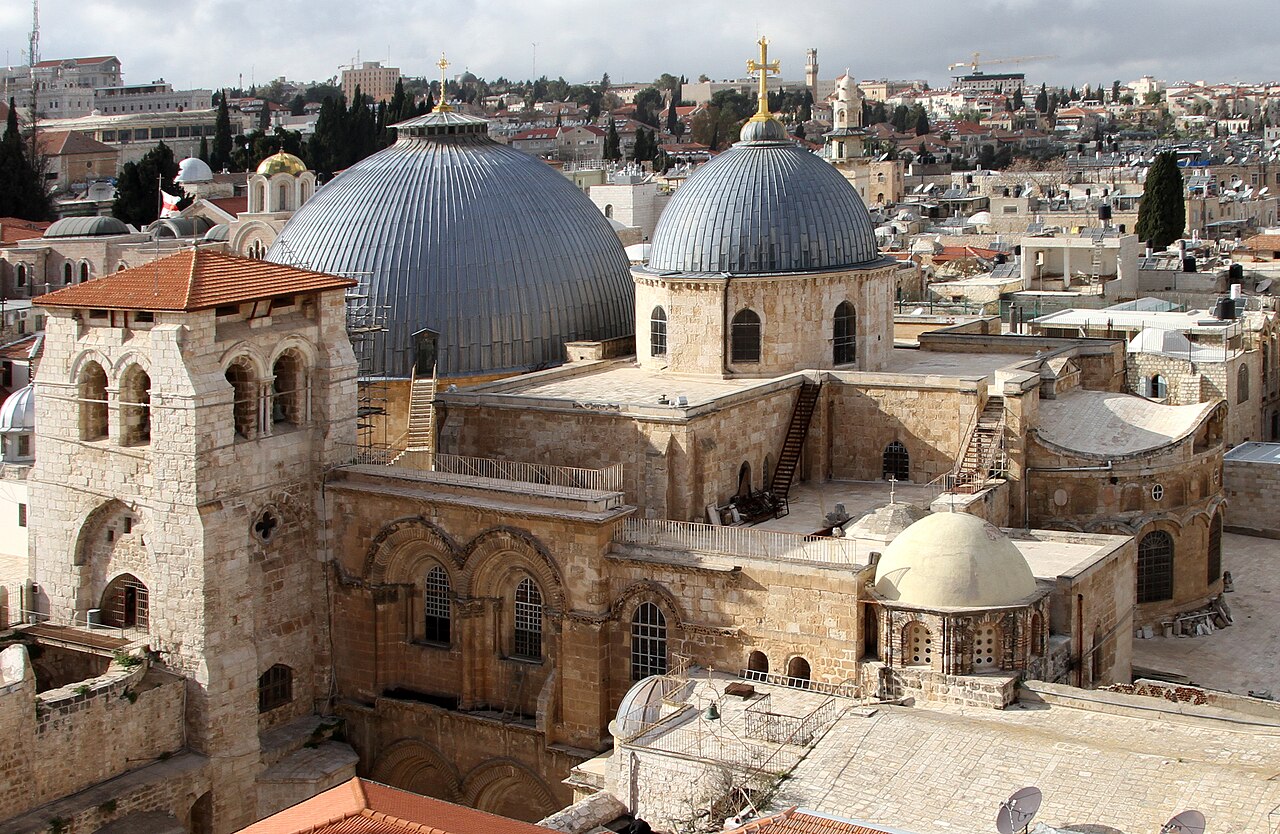

The story of this place
The building is best understood as a succession of churches rather than a monument from a single period. Constantine's fourth-century foundation, later destruction, medieval rebuilding and subsequent repairs all shaped the interior. Different Christian communities share responsibility for it, and their services are part of the place's identity. Christian tradition associates its central shrines with the crucifixion, burial and resurrection of Jesus.
What to notice
Follow the relationship between Calvary and the rotunda around the tomb before looking at individual chapels. The small shrine enclosing the tomb is the Aedicule; it is not the whole church. A plan helps explain why passages, stairs and worship spaces do not form an obvious sightseeing circuit.
Planning a visit
Allow flexibility for worship and queues rather than fixing a short stop between appointments. Clothing should be suitable for a church, and photography must respect services and worshippers. For a group pilgrimage, confirm arrangements with the relevant church community rather than assuming a general entrance also reserves a service.
Continue exploring
These places offer a geographical or historical connection. They are reading suggestions, not a pre-checked one-day route.
Sources & further reading
Editorial review: 20 November 2026. This is a researched introduction, not a report of an on-site inspection. Historical sources do not confirm current opening or access; check with the responsible operator before travelling.