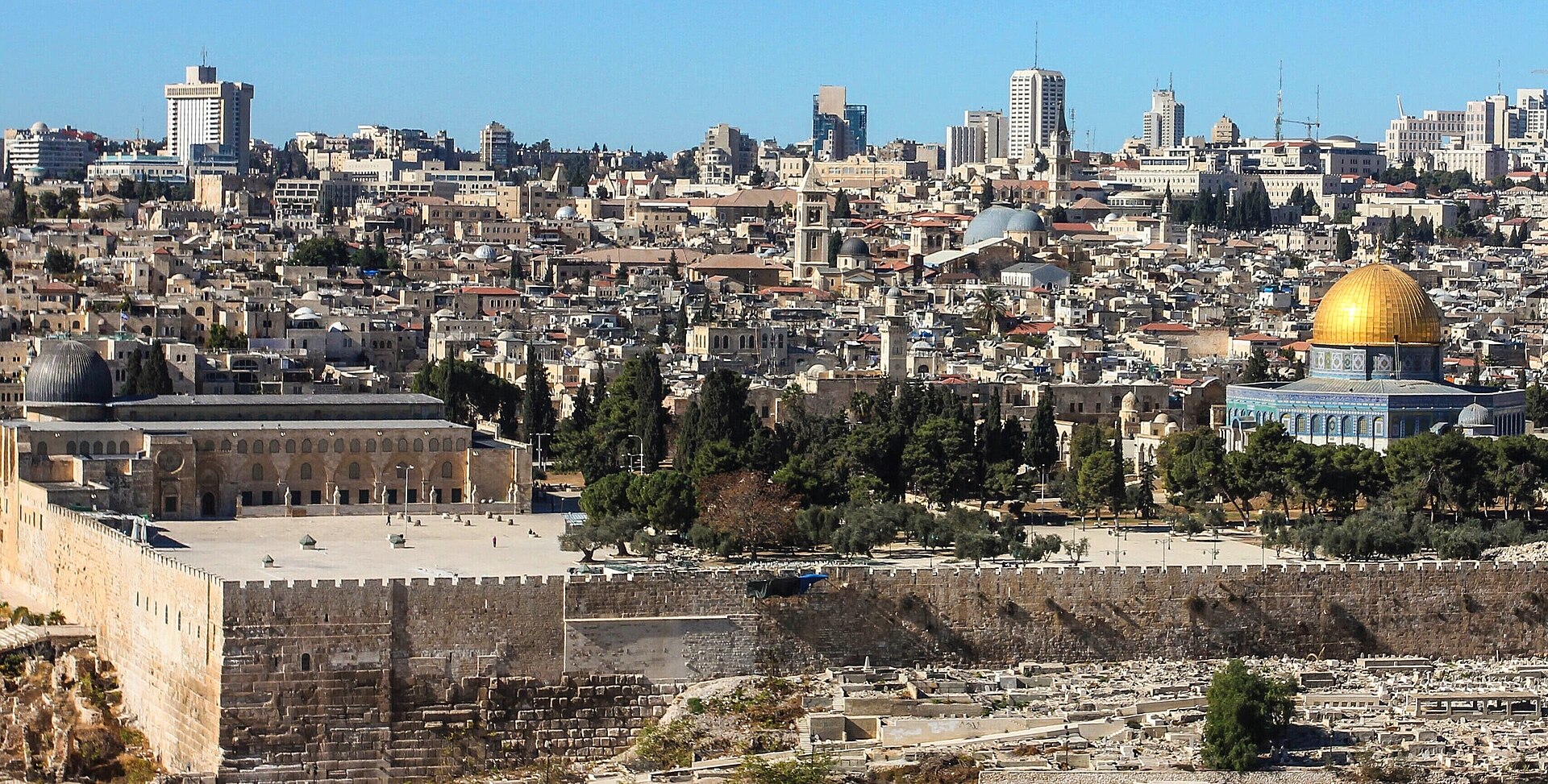

The journey came first; the book followed
Samuel Clemens travelled to the region in 1867 on the journey associated with the Quaker City excursion. The Innocents Abroad appeared in 1869. The Shapell Manuscript Foundation’s exhibition, organised with the New-York Historical Society, brings together documents that help separate the journey from the later published work. [1]
That distinction matters on a literary walk. A book is shaped for readers: scenes are selected, contrasts sharpened and a narrator’s personality made memorable. Travelling with a copy can be wonderfully revealing, provided you also notice what its author does not explain.
A documented entrance: Damascus Gate
Near the end of chapter 52, Twain describes entering Jerusalem through Damascus Gate. This gives a visit a secure geographical starting point. The streets you encounter now have continued to change, so the gate is an anchor for comparison rather than the opening of an exact reconstruction of his day. [2]
Pause outside before reading. First describe what you see in your own words; then compare the narrator’s sense of arrival with your experience. The exercise works even for readers who know little about Twain, because it makes the contrast between expectation and observation tangible.

The hotel story requires a careful map
Shapell’s research places Twain’s September 1867 stay in the Mediterranean Hotel’s second location near Damascus Gate. The establishment moved over time; its later location inside Jaffa Gate belongs to a different chapter. A familiar hotel name therefore does not justify identifying the wrong building as Twain’s lodging. [1]
Our proposed walk discusses this finding without promising entry to a historic hotel. A museum photograph or document can help explain the research, but reproducing such material online requires its own permission or reusable licence. The photographs on this page are separately credited modern views.
The Holy Sepulchre: satire and seriousness in one chapter
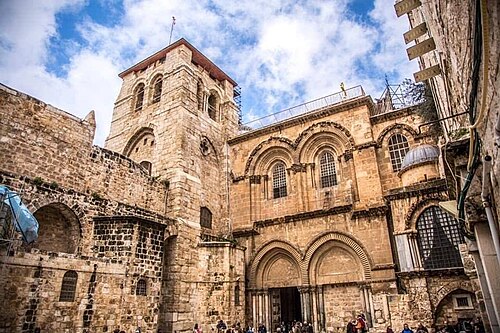
Chapter 53 moves from the city’s tightly packed buildings into the Church of the Holy Sepulchre. Twain questions the certainties presented to travellers and turns the tradition of Adam’s tomb into a comic family connection. Read the scene as literary performance, not as archaeological verification of a burial. [2]
His concluding passage also acknowledges the immense significance of the church for believers. That shift is worth discussing: the same narrator can mock an explanation and recognise the weight of devotion. A respectful visit need not repeat his tone towards worshippers to examine how his writing works.
Read extracts outside active worship areas and keep conversation quiet inside. The church is not a stage set for a book. Our Holy Sepulchre guide offers a broader introduction beyond the literary theme.
How to read a nineteenth-century visitor responsibly
Twain’s judgements about people and landscapes reflect his voice, expectations and historical setting. They should not be converted into a demographic survey, a verdict on every resident, or proof of a modern political claim. An arresting sentence can be a powerful piece of writing without being a complete description of a country.
For each extract, ask three questions: what did he observe directly; what did somebody tell him; and what is the joke or comparison doing? Then return to the place around you. This approach lets the source challenge the visitor while allowing the visitor to challenge the source.
A compact literary route
A proposed half-day can connect Damascus Gate, selected Old City lanes and the Holy Sepulchre, with a seated reading break outside the church. It is deliberately selective: recreating the whole regional journey would require a very different itinerary.
This theme suits readers, writers, book groups and travellers interested in how tourism shapes a place’s image. You do not need to finish the entire book beforehand. Chapters 52–53 give a useful starting point, and a few well-chosen passages are better company than a long list of quotations.
Explore this story with a guide
Our related excursions project offers Jerusalem Through Mark Twain’s Eyes: a Private Literary Walk. Read the proposed route, choose your starting city and request an English-language private visit. Guiding, transport and access are confirmed individually.
Sources and further reading
- Shapell Manuscript Foundation / New-York Historical Society — Mark Twain and the Holy Land. Museum exhibition and manuscript research, including the Mediterranean Hotel’s changing locations.
- Mark Twain — The Innocents Abroad (1869), chapters 52–53. Public-domain primary text in a teaching selection hosted by Carnegie Mellon University in Qatar; arrival and Jerusalem discussion on PDF pages 58–65. Twain’s voice is not a neutral historical survey.
Historical sources establish the background; current opening and access arrangements must be checked with the site operator. Photographs have their own licences, recorded alongside each image and in the photo-credit register.